Standard lunges can become monotonous in any fitness routine, making alternative lunges a game-changing addition to your lower body training arsenal. These lunge variations target different muscle groups, improve functional strength, and can help break through plateaus while adding much-needed variety to your workout regimen.
Key Takeaways
- Diverse muscle activation occurs with different lunge variations, providing more comprehensive lower body development
- Adding alternative lunges helps prevent plateaus and keeps workouts engaging
- Most lunge variations require minimal equipment, making them ideal for home or gym workouts
- Proper form is crucial for results and injury prevention with any lunge variation
- Progressive overload through increasing difficulty of lunge variations is key to continued strength gains
Why Alternative Lunges Deserve a Place in Your Workout Routine
Traditional lunges are a staple in many lower body training programs, and for good reason. They effectively target your quadriceps, hamstrings, glutes, and calves while improving balance and coordination. However, after performing the same movement pattern for weeks or months, your body adapts, and progress can stall.
Pro Tip: Equipment Matters
The quality of your equipment dramatically affects your workout results. See our equipment recommendations →
This is where alternative lunge variations become invaluable. By changing the angle, stance, movement pattern, or adding resistance, you can challenge your muscles in new ways. This variety not only prevents plateaus but also helps develop more balanced strength and muscle development throughout your lower body.
Each lunge variation in this guide offers unique benefits, whether you’re looking to increase power, improve unilateral strength, or target specific muscle groups more effectively. I’ve included step-by-step instructions to ensure proper form and maximize results from each variation.

1. Reverse Lunges: A Joint-Friendly Alternative
Reverse lunges are an excellent starting point for those new to lunge variations. Unlike forward lunges that can place significant stress on the knees, reverse lunges distribute weight more evenly and reduce knee strain while still effectively targeting the quadriceps, hamstrings, and glutes.
To perform a reverse lunge correctly:
- Stand with feet hip-width apart, maintaining good posture
- Step backward with one foot, creating distance between your feet
- Lower your body until both knees form approximately 90-degree angles
- Push through the heel of your front foot to return to the starting position
- Complete all reps on one side before switching legs, or alternate legs
For added challenge, try holding dumbbells at your sides or a barbell across your shoulders. This exercise pairs well with other lower body movements in a comprehensive workout regimen focused on strength development.
2. Walking Lunges: Boost Functional Strength and Endurance
Walking lunges add a dynamic element to traditional lunges by incorporating forward movement. This variation increases the challenge to your balance and coordination while effectively targeting the quadriceps, hamstrings, and glutes.
To execute walking lunges properly:
- Begin standing with feet hip-width apart
- Take a controlled step forward with your right foot
- Lower your body until both knees reach approximately 90-degree angles
- Push through your right heel to bring your left foot forward into the next lunge
- Continue alternating legs while moving forward
This movement requires more space than stationary lunges, making it ideal for outdoor workouts or gyms with long, open areas. Walking lunges can be performed with bodyweight alone or with added resistance like dumbbells or a weighted vest to increase intensity.
3. Lateral Lunges: Target Overlooked Muscles
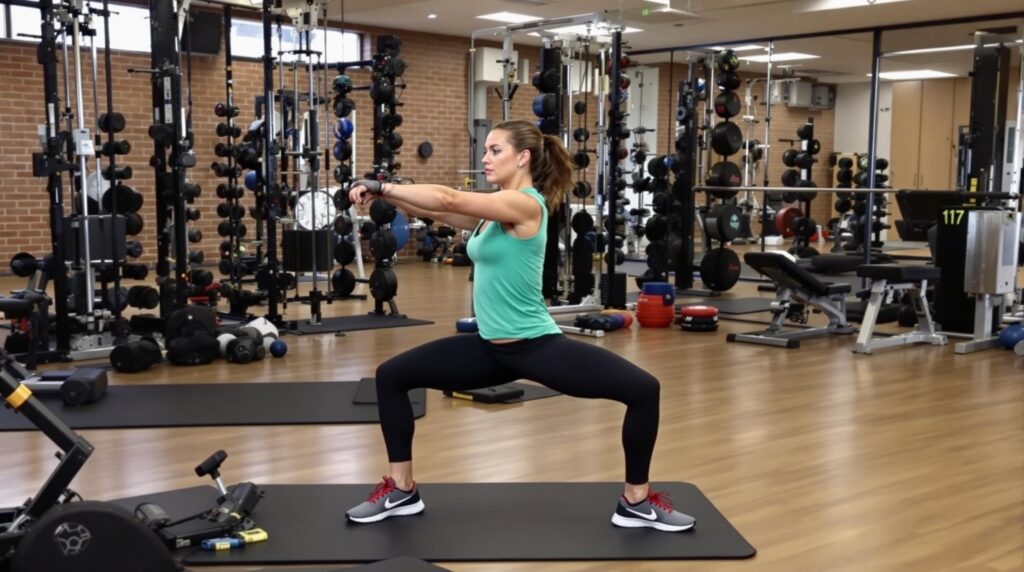
Most traditional leg exercises work in the sagittal plane (forward and backward movement), but lateral lunges add valuable side-to-side movement that targets the often-neglected adductors and abductors while still engaging the quadriceps and glutes.
To perform lateral lunges correctly:
- Stand with feet together or slightly apart
- Take a wide step to the side with one foot
- Bend the knee of your stepping leg while keeping the other leg straight
- Lower your hips back and down, keeping your chest up
- Push through the heel of your bent leg to return to the starting position
Lateral lunges are particularly beneficial for athletes in sports requiring lateral agility such as tennis, basketball, or soccer. They also help address muscle imbalances that can develop from only training in one plane of motion.
4. Curtsy Lunges: Enhance Hip Mobility and Glute Activation
Curtsy lunges, named for their resemblance to a formal curtsy, create a unique movement pattern that targets the gluteus medius (outer glute) more effectively than standard lunges. This muscle is crucial for hip stability and proper lower body alignment.
To execute curtsy lunges properly:
- Stand with feet hip-width apart
- Step your right foot behind and across your left foot (as if performing a curtsy)
- Lower your body until your front thigh is nearly parallel to the floor
- Push through your left heel to return to the starting position
- Complete all reps on one side before switching, or alternate sides
This exercise not only strengthens the glutes but also improves hip mobility and functional movement patterns. Adding curtsy lunges to your routine can help address weaknesses in the hip abductors that might contribute to knee or lower back issues.
5. Bulgarian Split Squats: Maximize Unilateral Strength
While technically a split squat rather than a lunge, the Bulgarian split squat deserves inclusion for its unparalleled effectiveness at building single-leg strength. By elevating the rear foot, this exercise intensifies the work on the front leg while challenging your balance and stability.
To perform Bulgarian split squats correctly:
- Stand about two feet in front of a bench or step
- Place the top of your rear foot on the bench
- Lower your body by bending your front knee until it forms about a 90-degree angle
- Keep your torso upright and core engaged
- Push through the heel of your front foot to return to the starting position
This challenging exercise delivers remarkable results for quadriceps development while also engaging the glutes and hamstrings effectively. It’s a staple in many muscle-building workout plans for good reason.
6. Jumping Lunges: Add Power and Cardio Benefits
For those seeking to add a plyometric element to their training, jumping lunges combine strength work with explosive power development. This variation significantly increases calorie burn while improving athletic performance.
To execute jumping lunges safely:
- Begin in a lunge position with your right foot forward
- Lower into the lunge until both knees form 90-degree angles
- Explosively jump upward, switching leg positions mid-air
- Land softly with your left foot forward and right foot back
- Immediately lower into the next lunge and repeat
Due to their high-impact nature, jumping lunges should be incorporated gradually, especially for beginners. Start with a small number of repetitions and focus on landing mechanics before increasing volume. These are excellent for HIIT workouts or as a finisher after strength training.
7. Deficit Lunges: Increase Range of Motion
Deficit lunges increase the depth of movement by having you step off an elevated surface. This extended range of motion places greater demands on your muscles and improves mobility throughout the lower body.
To perform deficit lunges correctly:
- Stand on a sturdy platform (like a weight plate or step) about 2-4 inches high
- Step backward or forward off the platform into a lunge
- Lower deeper than a standard lunge due to the height difference
- Push through your working leg to return to the starting position
- Focus on maintaining balance and control throughout the movement
The increased range of motion in deficit lunges can help improve flexibility and mobility while challenging your muscles more completely. This variation is particularly effective for breaking through plateaus in lower body development.
8. Pulse Lunges: Enhance Muscle Endurance
Pulse lunges incorporate small, controlled movements at the bottom of a lunge to increase time under tension—a key factor for muscle growth. This variation builds muscular endurance and strengthens the mind-muscle connection.
To execute pulse lunges effectively:
- Get into a standard lunge position with one foot forward
- Lower until both knees form approximately 90-degree angles
- Instead of returning to standing, pulse up and down 2-3 inches
- Perform 3-5 pulses before returning to the starting position
- Keep core engaged and maintain proper alignment throughout
This technique can be applied to any lunge variation to increase its difficulty without adding weight. The burning sensation you’ll feel indicates the effective targeting of the muscles through extended time under tension.
9. Overhead Lunges: Engage Core and Improve Posture
Adding an overhead element to lunges transforms them into a full-body exercise that enhances core engagement and challenges your balance, stability, and posture. This variation can be performed with a barbell, dumbbells, or even a medicine ball.
To perform overhead lunges safely:
- Hold weight(s) directly over your head with arms extended
- Engage your core and maintain a neutral spine
- Perform a forward, reverse, or walking lunge while keeping the weight overhead
- Focus on keeping your torso upright throughout the movement
- Return to the starting position with control
The overhead position forces your core to work harder to maintain stability while performing the lunge.